
Curiosity and one Labrador who Changed Everything
We asked canine therapist Lisa Binch to tell us how her thinking, firmly rooted in science and evidence, developed beyond her expectations when treating one of her long term patients, Blake the labrador, in clinic last year. What unfolded was driven by Lisa’s equal determination to keep an open mind at all times. She discovered more than clinical science can explain.
Some background
Before I begin, it’s important to explain where this reflection comes from.
I’m a musculoskeletal therapist based in Nottingham, working across two clinics. One is a treatment and wellness clinic focused on clinical canine massage therapy, osteopathy, pain management, and nutrition. The other is a sport and performance clinic dedicated to rehabilitation, conditioning, and fitness for sporting and working dogs.
My background is firmly rooted in science. I hold BSc and MSc degrees in genetics, medical microbiology, and biochemistry. My clinical practice has always been evidence-led, shaped by physiology, biomechanics, and research:
- I believe strongly that facts should come before techniques, and that hypotheses should come before conclusions
- I don’t practise “energy healing”
- I don’t abandon science in favour of mysticism
BUT I do believe in staying curious.
That belief was deeply challenged by one dog, Blake — who completely changed how I understand my work.
Evidence first… but never evidence only
I wouldn’t describe myself as sceptical in a negative sense, but I am scientifically disciplined. My default position has always been: if we can’t explain it, we question it, not worship it, and not dismiss it either. Science advances because we allow questions to exist before we have perfect answers.
Clinical practice, especially hands-on bodywork, requires the same humility. Some experiences don’t sit neatly inside current models. Ignoring them outright would be just as unscientific as accepting them without reflection. This reflection is a professional account of one of those experiences — and how it reshaped my understanding of myofascial release.
A quick word on myofascial release
Fascia is the connective tissue network that surrounds and interpenetrates every muscle, nerve, blood vessel, and organ in the body. It plays a major role in movement, force transmission, proprioception, and pain.
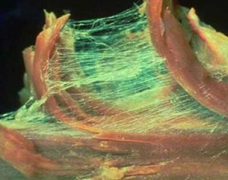
Myofascial release (MFR) uses gentle, sustained, low-load pressure to influence this system. In dogs, MFR can help with:
- Reducing protective muscle guarding
- Improving tissue glide and hydration
- Supporting postural change and improving mobility
- Downregulating the nervous system
- Modulating chronic pain patterns
When performing these techniques – It’s not about force. It’s about listening to tissue. And it is not a “quick approach”. True myofascial work is skilled bodywork that takes time, experience, and refined sensory awareness to develop.
Which brings me to Blake.
Blake: The Labrador who changed my clinical direction
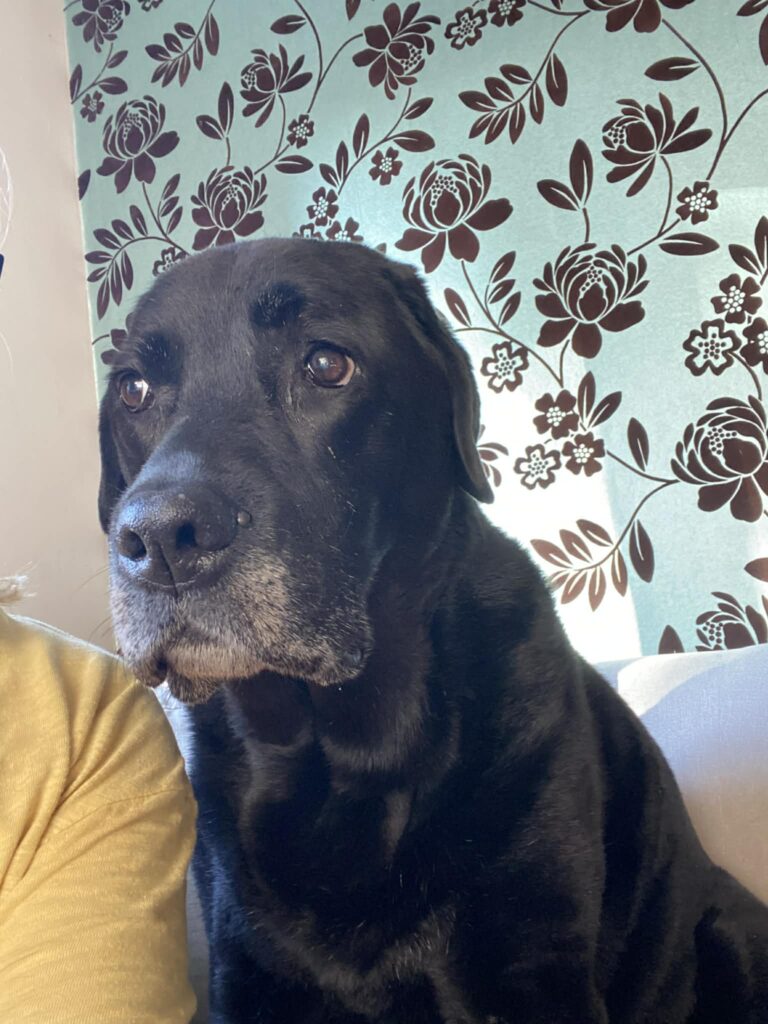
Blake is a Labrador retriever who had been coming to me for regular treatment for several years. At the time of the session that changed everything, he was eleven years old. He is a typical Labrador — affectionate, opinionated, sometimes restless in sessions, often needing comfort breaks. He has always responded well to treatment, but nothing about his case was unusual.
Until one session wasn’t.
The structure of the session was clinically unremarkable:
- Same techniques
- Same environment
- Same approach
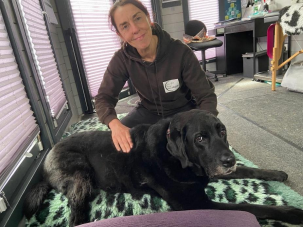
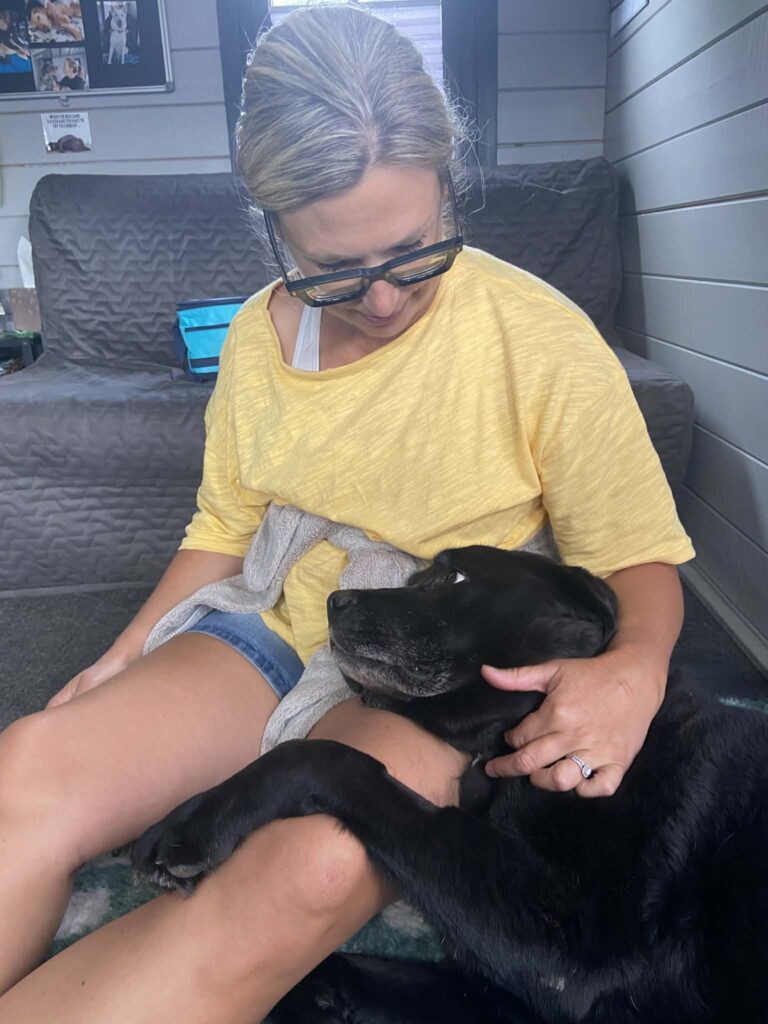
But as I began sustained myofascial release, I experienced something I had never felt before: an intense sensation of warmth, vibration, and pressure through my forearms and hands. It wasn’t emotional, imaginative, or “spiritual” — it was a very real, physical, somatic experience.
At the same time, Blake entered an extraordinarily deep state of relaxation. He fell into a sleep so profound that he began snoring — something he had never done before in years of treatment. As I continued working, the sensations in my arms intensified. Blake’s tissue softened visibly. His muscle tone reduced. His posture shifted. He melted into me and remained deeply settled, calm, and for want of a better word, content.
Fascial lines, fasciculations and what I observed with Blake
Many therapists who regularly practise myofascial release will recognise a familiar phenomenon: as tissue begins to respond, you may observe fasciculations, small, involuntary muscle twitches or rippling movements across the body. These responses are commonly seen during effective myofascial work and are generally understood as signs of neuromuscular down-regulation and changing tone within the fascial system.
They are often associated with both active and latent trigger points, where areas of heightened neuromuscular activity begin to deactivate. Clinically, they reflect shifts in motor unit recruitment, altered afferent input, and changing autonomic tone. What is particularly interesting, however, is that these releases do not always occur only at the site being treated.
When myofascial techniques are applied with sustained, low-load pressure and sufficient time, releases are often observed remotely, along interconnected fascial pathways rather than solely within the area of contact. This aligns with the concept of myofascial lines (or fascial meridians), most widely described by Thomas Myers in Anatomy Trains, and more recently explored in canine models by Elbrønd (2024). These lines describe continuous chains of interconnected myofascial tissue that transmit tension, force, and movement throughout the body, coordinating global movement patterns rather than isolated muscle actions.
During Blake’s session, this phenomenon was strikingly visible. While working locally, I observed widespread fasciculations and sequential releases occurring across multiple myofascial lines, particularly:
- The Superficial Dorsal Line
- The Lateral Line
- The Spiral Line
- The Functional Lines
There were visible rippling movements, tissue softening, and postural changes in regions I was not directly treating at that moment.
Clinically, this reinforced what experienced bodyworkers often observe: effective myofascial release is not purely local or mechanical. It operates within a global, interconnected system, where change in one region can propagate throughout the entire fascial network.
Blake’s body was not just responding at one point — it was reorganising as a whole.
Fascia, force transmission and tensegrity
This global response becomes more understandable when viewed through the lens of tensegrity. Biological tensegrity describes how living structures maintain integrity through a balance of continuous tension and localised compression. In the body, fascia acts as a continuous tensional network, while bones provide discontinuous compression. Stability and movement emerge not from isolated parts, but from the coordinated behaviour of the entire system.
From this perspective, the musculoskeletal system does not function as individual muscles pulling on bones, but as a unified tensional structure where forces applied in one area can influence distant regions. Myofascial release, when applied gently and sustained over time, may influence this tensional network, allowing the system to redistribute load, reduce protective holding patterns, and reorganise movement strategies. What appears as a “remote” release is, in fact, a predictable response within a connected tensional architecture.
Seen this way, Blake’s widespread fascial responses were not mysterious — they were physically coherent.
After Blake’s treatment session
After the session, I felt completely depleted. Not emotionally but physically. I needed to ground myself. I felt exhausted in a way I never had after clinical work.
And my first thought wasn’t, that was energy.
It was: what on earth just happened?
From experience to research (because of course I did)
Being me, I went straight back to the science. What I found was reassuring. Modern research increasingly frames myofascial release not as a purely mechanical intervention, but as a neurobiological one. Fascia is richly innervated with mechanoreceptors, nociceptors, and interstitial receptors, all of which communicate directly with the autonomic nervous system.
Sustained myofascial work has been associated with:
- Changes in fascial hydration and viscosity
- Fibroblast activity and extracellular matrix remodelling
- Parasympathetic nervous system activation
- Central and peripheral pain modulation
What was the “energy” feeling?
Clinically and scientifically, the sensations I experienced can be explained through well-described mechanisms, including:
- Increased afferent sensory input during sustained pressure
- Heightened interoceptive awareness during parasympathetic dominance
- Vasodilation and local thermal changes
- Oscillatory and resonant responses within neuromuscular tissue
Whether we label that as “energy” or not is, ultimately, irrelevant. What matters is the outcome.
Why does everything have to be either “energy” or “evidence”?
The outcomes of Blake’s session were clear:
- Profound tissue change
- Improved posture and mobility
- Autonomic regulation
- Deep relaxation
- Reduced pain sensitivity
Science doesn’t yet have perfect tools to measure all aspects of therapeutic touch — but absence of measurement is not absence of effect.
Many accepted physiological phenomena were once dismissed simply because we didn’t yet know how to measure them.
Blake was my clinical apprenticeship moment
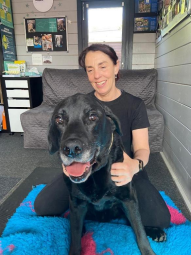
Since Blake, myofascial release has become a central focus of my work and research. Not just as a technique — but as a clinical language between nervous system, tissue, and therapist. As a result my
- Treatments have changed
- Priorities have changed
- Curiosity has deepened
In a strange way, Blake feels like my apprenticeship moment, the dog who quietly forced me to level up as a therapist.
Not into something less scientific. But into something more skilled, more embodied, and more observant.
True myofascial release is not something you do It’s something you learn to feel.
And that takes years.
Closing thoughts
This reflection is not an endorsement of uncritical thinking, “energy healing”, or unsupported claims. It’s an acknowledgement that skilled clinical practice sometimes reveals phenomena that science has not yet fully explained.
As therapists it’s our responsibility is to:
- Observe carefully
- Question respectfully
- Protect our patients
- And keep learning
Blake reminded me that evidence-based practice and open-minded practice are not opposites. They are partners.
Thank you to Blake for the important lesson of true myofascial release work and his wonderful caregiver Alexa, for their help and support throughout my journey as a canine musculoskeletal therapist.
References
- Langevin, H. M., & Huijing, P. A. (2009). Communicating about fascia: history,
pitfalls, and recommendations. International Journal of Therapeutic Massage &
Bodywork, 2(4), 3–8. - Schleip, R., Findley, T. W., Chaitow, L., & Huijing, P. (2012). Fascia: The
Tensional Network of the Human Body. Elsevier. - Stecco, C., Schleip, R., Yucesoy, C. A., & Findley, T. (2018). Fascial function in
movement and proprioception. Current Pain and Headache Reports, 22(6), 38. - Canine Myofascial Kinetic Lines: Elbrønd, V. (2024) Canine Myofascial Kinetic
Lines: A Descriptive Dissection Study Including Related Function and
Locomotion and Comparison of the Human and Equine Myofascial Kinetic
Lines. Open Journal of Veterinary Medicine, 14, 229-256.
Lise Binch
Lisa of East Midlands Clinical Canine Massage and Rehabilitation is a qualified canine musculoskeletal practitioner specialising in hands on therapeutic interventions to support comfort and mobility in dogs. She integrates clinical canine massage therapy with functional osteopathic body work techniques to deliver safe evidence-based care, individually tailored to each dog following thorough assessment.
Lisa works within her professional scope in collaboration with veterinary professionals where appropriate with the aim of optimising musculoskeletal function supporting rehabilitation and enhancing overall quality of life for each dog in my care. Her approach integrates a wide range of advanced techniques, including:
- Skilled canine massage methods such as Swedish, sports, deep tissue, trigger point therapy
- Advanced myofascial release techniques, including both direct and indirect myofascial release, myofascial unwinding, and Myofascial Release Lenton Methods™
- Craniosacral therapy
- Passive stretching, joint mobilisations, oscillations, and articulations
- Electrotherapies, including therapeutic laser
- Individually prescribed canine rehabilitation and fitness exercise programs
These methods are supported by research and are designed to alleviate pain, restore mobility, and improve overall wellbeing.
Lise has recently completed her qualifications as a veterinary pain practitioner, expanding her ability to support dogs experiencing both acute and chronic pain conditions. She is also a licensed canine fitness and conditioning coach through the Canine Conditioning Academy, enabling her to design and deliver safe, functional strength, conditioning, and performance programmes for sporting and working dogs, as well as for those recovering from injury.
She has also completed a clinical nutrition diploma, further broadening her scope to offer evidence-based nutritional advice and consultations to support canine health, rehabilitation, and long-term wellbeing.
Disclaimer – Where blogs have been created by a guest author, CAM4Animals has reproduced this in good faith but cannot be held responsible for any inaccuracies of information in it or any use you make of this information.
The veterinary Surgeon’s Act 1966 restricts the treatment of animals (usually other than your own*) by anyone other than a qualified vet. Always consult a veterinary surgeon if you are concerned about your animal’s health. *For full details visit the RCVS website